
Go to main contentsGo to main menu
Thursday, July 2, 2026 at 1:53 PM

Josephine White: Experiencing World War II On the Homefront

Josephine White: Experiencing World War II On the Homefront
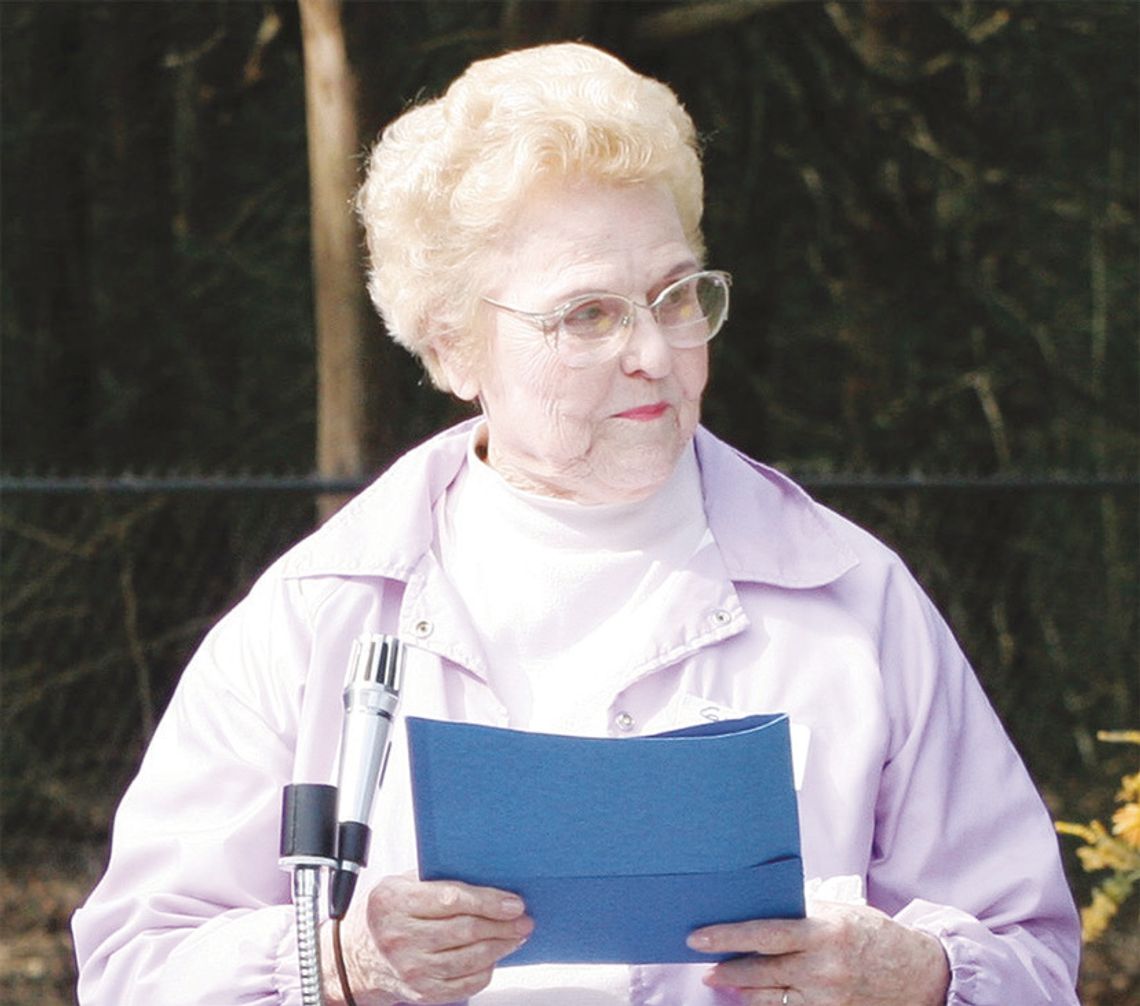
Josephine White speaking at a Fayette County Historical Commission event in 2006.

Josephine White passed away on February 8, 2026, at the age of 105. She was much loved and respected by her fellow Historical Commission members, who chose to honor her memory using her own written words from 2014, when Jo reminisced about her experiences on the home front in the decade that included World War II. She had arrived in San Antonio in July 1938 as a young high school graduate from Beeville: “It was also an exciting place for a young lady to live in those pre-WWII days. There was no shortage of young men. The United States was already gearing up for war. Randolph Field, just north of San Antonio was the airbase in which future pilots were being trained for the Army Air Force. Young men took their basic training there.

They were called Cadets.

They were college-trained and single. Their training took several months and if they didn't ‘wash-out’ they got their Wings, became Second Lieutenants…those who became Army officers were transferred elsewhere for advanced training.

“San Antonio was called ‘The Mother-in-Law’ of the Army, and many San Antonio girls made good marriages with military men, but the main reason I did not date Randolph Field Cadets was because I had learned that the Cadets, when they graduated and moved on, would write the names and telephone numbers of young ladies they had dated on the walls of the restrooms for the next class of Cadets. The girls who were passed from class

to class of Cadets were called 'Cadet Widows' and I didn't want to become one of them. It was not a complimentary term.”

Jo met Melvin Ashley White and they married on November 23, 1940, beginning their life together in San Antonio. They were on a picnic in the hill country when Pearl Harbor was struck by the Japanese on December 7, 1941: “When we learned that the Japanese had attacked Pearl Harbor, most people, including me, did not know where Pearl Harbor was. Melvin knew because both of his brothers, Douglas and Jack White, were career Navy and had been in and out of Pearl Harbor many times. Melvin's parents were extremely worried as they were not sure if either of their sons had been at Pearl Harbor on that day.

They were unable to make phone calls, but as soon as possible, both sons did send letters saying that they were elsewhere at the time of the attack and were not at Pearl Harbor. So began the tense- filled days of World War II.

“A couple of days after Pearl Harbor, when Pres- ident Roosevelt and Con gress declared war on both Germany and Japan, San Antonio settled down for a long hard war. Soldiers and Army vehicles were everywhere on the streets.

“It seems that almost half of the civilian doctors were not drafted, but ‘procured’ for military service.

This threw a terrific burden on the civilian doctors.”

Jo went on to describe wartime rationing and scarcity: “Gasoline was rationed and citizens were given books of ration stamps.

There were different categories of stamps. I remem- ber A, B, and C stamps. Citizens were classified ac cording to the kind of work they did. My employer, a busy physician, was given C stamps. The Ration Board, under the assumption that doctors were still making numerous house calls, was generous with physicians.

My employer could not use all the stamps he was given.

After the war began, he was so busy at the hospital and in the office that he had lit tle time for house calls.

“I worked in downtown San Antonio and could easily ride the bus, and I was in the lowest category which I think was the A-stamp category. San Antonio did have the best bus service, and bus rides were cheap, three tokens for a quarter.

Once one got into town, one could transfer to another bus on another line, and all one had to do was ask for a transfer.

“Almost every man and many women smoked cigarettes. I do not remember that they were actually rationed; they just became ‘unavailable.’ They were taken mostly for the men overseas. The slogan 'Lucky Strike Has Gone to War' was seen on billboards everywhere. Loose tobacco was available and smokers bought cigarette machines and rolled their own cigarettes. Even non-smoking wives would help them.

Cigars were available for a long time and many men switched from cigarettes to cigars.

“Having enough meat to eat was important to Texans, but meat was rationed according to the size of one's family. Until my husband was finally drafted late in the war, we ate many meals at the home of his parents, so I usually gave Jessie Lee White, my mother-in-law, most of our meat rationing stamps. I kept only enough stamps for bacon for our breakfasts.

“My father-in-law, Will White, was a great fisher - man and he went fishing as often as he could. We had many fish dinners. He was also a bird hunter, so we had many fine meals of quail or dove meat. Will White had a number of deer hunters who worked under him, and we often had venison roast and steaks for meals. One Thanksgiving, we actually had a wild turkey. Jessie Lee White was a wonderful cook, and she managed to cook the game meals so that they were tasty, tender and not too ‘wild tasting.’

“Sugar was rationed.

Since I was working, I had little time for baking, and I gave most of my sugar stamps to my mother-inlaw. Her pies were the best.

She made cookies and can- dies for Christmas to die for.

“I think that as an active young lady who was employed, I needed all my shoe stamps.

“One thing that I was most concerned about was not having enough nylon hose to last through the war…I tried to keep an adequate supply of them, but they soon became non-existent as nylon materials were used to make parachutes. I was on my last pair of nylon hose, with a runner in one of them, when near the end of the war, Joskes of Texas, got in a limited supply of nylon hose. As a preferred charge customer, I was allowed 2 pairs.

“Many other items which were not rationed but became scarce to non-existent as existing inventory stocks were depleted. Those items included furniture and most household items.

When my son, David, was born in 1944, I could not find a furniture store with a rocking chair, and I had to buy an antique rocker.

Scarcity of materials continued even after the war and price controls were put into effect: “In 1947 we were in the process of trying to build a home on some acreage we had north of San Antonio.

Before we were half fin ished, price controls went off and building materials skyrocketed.

“There was such a short- age of automobiles that five- and six-year-old used cars sold for as much as they had cost originally. The used car prices held up for a while after the war and new cars again became available.

My father-in-law's car was probably a 1939 Chevrolet.

When he decided to buy a new car in probably 1947 or 48, his trade-in on his old car was as much as he paid for it. He was delighted, but a few years later when he again bought a new car, he couldn't understand why his trade-in car had depreciated from its original price.

“Toward the end of the war, stores began taking advance orders for all sorts of things. Customers could buy major household items which were not available.

When the war ended and manufacturers could again make civilian products, the item would be delivered.

I bought a feather-weight Singer sewing machine a year before my machine was available. Singer Sew- ing Machine Company had been making machine-gun shells for the Army.”

Like Jo, we believe it is important to pass along memories, and we encourage everyone the same.


Share
Rate

e-Edition