
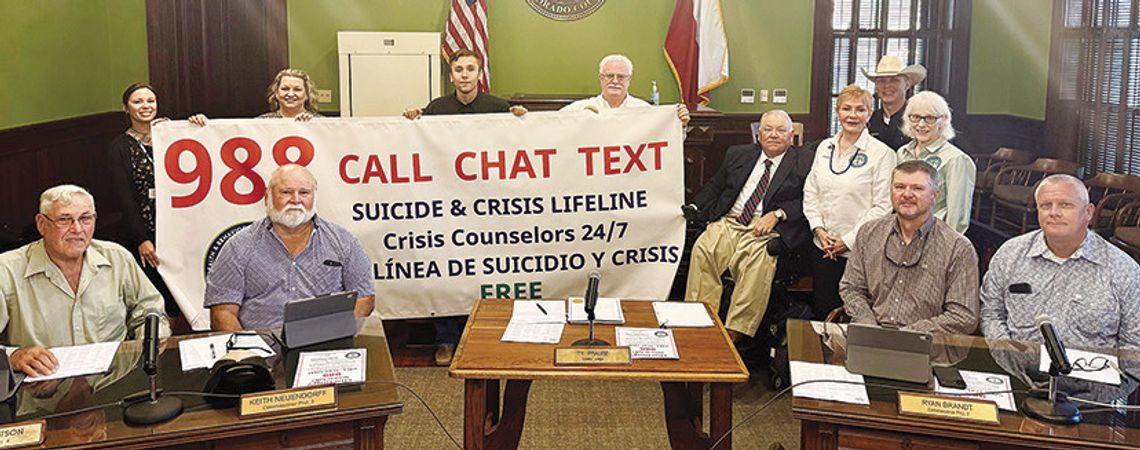
September is National Suicide Prevention Month — a time when communities across the country are encouraged to talk openly about suicide, recognize warning signs and most importantly, understand that suicide prevention belongs to all of us.
This year, The Wellness Council of Greater Colorado Valley is shining a light on a connection that deserves more attention: Anxiety and Suicide Risk.
We often think of anxiety as ‘just worrying too much.’ We may tell someone, “Calm down … You'll be fine.”
But anxiety disorders are much more than ordinary worry; they are brain disorders! It is not because a person is weak or has a character flaw.
Anxiety in general is a normal human response to danger or uncertainty. It can help us prepare for a difficult conversation, an exam, a medical procedure or a difficult decision. But when anxiety becomes persistent, excessive, difficult to control or disruptive to everyday life, it may become an Anxiety Disorder.
And anxiety can be profoundly distressing.
Research has consistently found an association between anxiety symptoms and suicidal thoughts and behaviors. Some studies have found substantially increased suicide risk among people experiencing significant anxiety symptoms. One study, for example, found that people reporting recent anxiety symptoms were about five times more likely to screen positive for suicide risk. Other research has found that diagnosed Anxiety Disorders are associated with increased risk for suicide attempts.
The important message is not that everyone with anxiety will become suicidal – they won’t!
The message is that severe anxiety should not be ignored.
Think about what persistent anxiety can do to a person's world. Sleep may become difficult. Concentration can suffer. Physical symptoms—racing heart, shortness of breath, trembling, headaches, stomach problems and muscle tension—can become frightening. A person may begin avoiding school, work, church, social activities, driving, travel or simply leaving home.
Over time, life can become smaller. The individual begins to isolate.
And when someone feels trapped by overwhelming emotional or physical distress, hopelessness can develop.
That is why recognizing anxiety can be an important part of suicide prevention.
We do not need to diagnose someone. We simply need to know the symptoms and take notice of an individual – friend or family – and reach out to them.
• Has a friend become unusually withdrawn?
• Are they increasingly anxious, agitated or overwhelmed?
• Are they sleeping much more—or much less?
• Has a family member stopped doing things they once enjoyed?
• Are they talking about feeling trapped or hopeless?
• Are they saying they feel like a burden to everyone?
• Have they stated they have no reason to live?
These are warning signs that deserve attention. The National Institute of Mental Health encourages us to take changes in behavior and expressions of hopelessness, unbearable emotional pain or thoughts of death seriously.
And what can we do? LISTEN! And don’t try to 'fix' everything.
Take the person's fear seriously—even if the fear doesn't make sense to you.
Instead of saying, “You need to settle down,” try saying, “I can see that you're really struggling. I'm here for you.”
If you are concerned someone may be thinking about suicide, do not be silent! Ask them directly, “Are you thinking about suicide?” Call immediately for help!
Asking does not put the idea into someone's head. It can release a lot of the emotionality behind the anxiety and open an important door to help.
The Mental Health First Aid Class that Texana Behavioral Clinic and The Wellness Council have been sponsoring locally – seven classes total to date – teaches the ALGEE technique to assist you if you have concerns about a person’s mental status:
• Assess for suicide or harm
• Listen non-judgmentally • Give reassurance and information
• Encourage appropriate professional help • Encourage self-help and other supportive strategies.
And remember this: anxiety is treatable.
Psychotherapy, including Cognitive Behavioral Therapy (CBT), medications when appropriate, healthy routines, supportive relationships and other evidence-based approaches can help people regain control of their lives.
You don't have to wait for a crisis before you show your concern and offer assistance. Prevention can be rather simple: listening, showing you care and you are aware can remove the person’s sense that they are alone.
Colorado County has a Mental Health Deputy who is trained to talk with and provide support to individuals with Anxiety, Depression, PTSD disorders, as well as other mental health disorders. Simply call 911 Dispatcher and let them know you have concerns about a friend, family member, or neighbor and you’d like the Mental Health Deputy to make a visit. Of course, if there is a crisis, tell the 911 Dispatcher it is a crisis so immediate help can be sent Additionally, the National Crisis Hotline -- 988 – is available 24/7 at no cost to the caller.
Individuals can Call-Text-Chat; there are counselors available also especially for Veterans, our Spanish speaking citizens, and other special populations.
In an immediate life-threatening emergency, call 911.